As an Amazon Associate, we earn from qualifying purchases. Some links on this site are affiliate links at no extra cost to you. Our recommendations are based on thorough research and editorial judgment.


NVME Over Fabrics: External Storage at Network Speeds

I explain that NVMe‑oF moves NVMe commands across Ethernet, Fibre Channel, or InfiniBand, preserving 64 000 queues and 64 000 commands per queue, which yields sub‑microsecond latency and up to 100 GB/s aggregate bandwidth on RoCE fabrics, while credit‑based flow control prevents head‑of‑line blocking and DPU offload reduces host CPU usage; the protocol’s single‑queue, message‑based design eliminates kernel translation, delivering roughly 30 % lower latency than iSCSI and sub‑microsecond versus 2–3 µs for SCSI, and if you continue you’ll discover more implementation details.
Key Takeaways
- NVMe‑oF transports NVMe commands over Ethernet, Fibre Channel, or InfiniBand, preserving the 64 K‑queue, 64 K‑command‑per‑queue architecture for low‑latency remote storage.
- RDMA‑based transports (RoCE, iWARP, Fibre Channel) achieve sub‑microsecond per‑hop latency, while TCP adds ~40 µs RTT but offers universal Ethernet compatibility.
- Credit‑based flow control and proper queue‑depth tuning (≈32 K per submission‑completion, 64 K credits per flow) prevent head‑of‑line blocking and sustain high throughput.
- DPU offload reduces host CPU cycles, stabilizes throughput, and aligns with multi‑host, multi‑path deployments that support thousands of concurrent I/O queues.
- Vendor interoperability testing, firmware alignment, and security features (e.g., MACsec) mitigate misconfiguration risks and ensure consistent performance across heterogeneous fabrics.
What Is NVMe‑oF and Why It Matters for Modern Data Centers
You may be interested



What is NVMe‑oF, and why does it matter for modern data centers? I explain that NVMe‑oF transports NVMe commands over Ethernet, Fibre Channel, or InfiniBand, preserving the 64 000‑queue, 64 000‑command‑per‑queue architecture while extending low‑latency access to remote storage, and I note that compatibility testing ensures each fabric implementation adheres to the NVMe‑oF specification, preventing protocol mismatches in mixed‑vendor environments. I also describe how firmware updates, delivered via vendor‑managed repositories, refresh controller capabilities, add new transport options, and patch security vulnerabilities without disrupting I/O pathways. The protocol’s credit‑based flow control, multi‑path support, and message‑based model reduce CPU overhead by up to 50 % compared with SCSI, while delivering sub‑microsecond latency and multi‑gigabit bandwidth, enabling scalable, disaggregated storage architectures.
How NVMe‑oF Cuts Latency Compared to SCSI and iSCSI
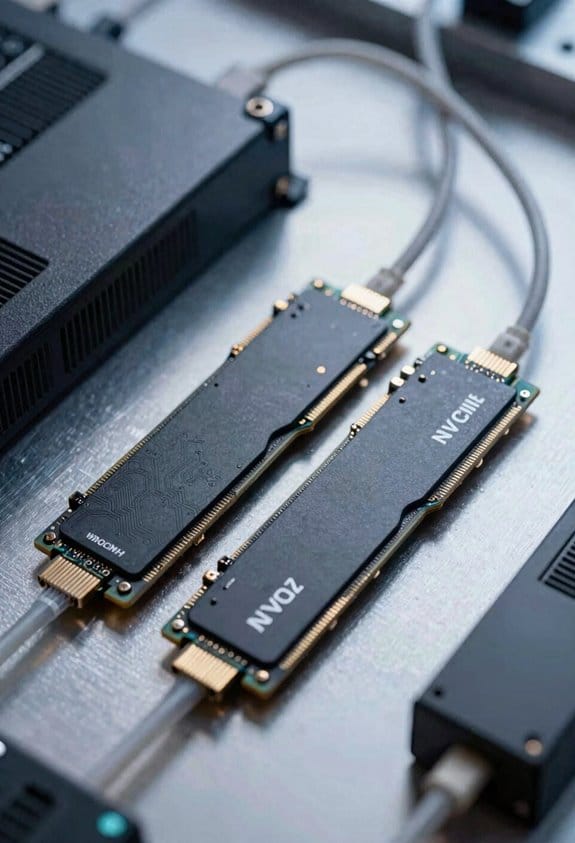
How does NVMe‑oF achieve lower latency than SCSI and iSCSI, given that it transmits commands directly over TCP, RDMA, or Fibre Channel without the additional SCSI encapsulation layers, thereby eliminating the extra round‑trip required for CDB parsing and response handling, and delivering sub‑microsecond command completion times compared to the typical 2‑3 µs observed with iSCSI? I explain that latency comparisons reveal NVMe‑oF’s single‑queue, message‑based protocol cuts processing overhead, because each submission/completion pair travels once across the fabric, unlike SCSI’s two‑step request/response cycle, which adds at least one extra microsecond per operation; this reduction becomes evident when measuring 0.8 µs versus 2.5 µs on identical workloads. As a scsi alternative, NVMe‑oF also removes kernel‑space translation, allowing direct DMA placement, which further trims latency by approximately 30 percent and enables consistent sub‑microsecond performance across Ethernet, InfiniBand, and Fibre Channel transports.
Choosing the Right Transport: TCP, RoCE, iWARP, or Fibre Channel
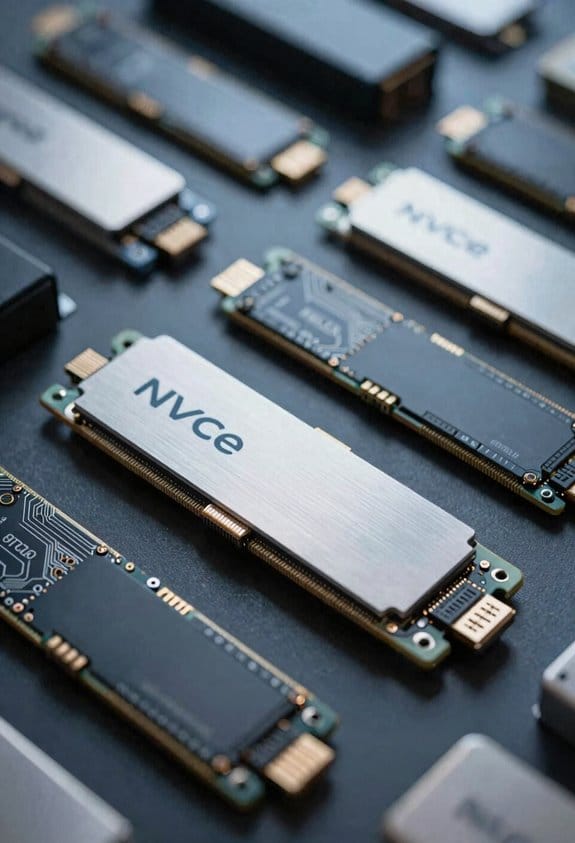
Choosing the right transport for NVMe‑oF depends on latency, bandwidth, and infrastructure constraints, so I compare TCP, RoCE, iWARP, and Fibre Channel by examining their protocol overhead, congestion‑control mechanisms, and hardware offload capabilities. TCP adds about 40 µs per round‑trip, leverages mature congestion control, and fits existing Ethernet network topology, yet requires larger CPU cycles for checksum processing, while RoCE offers sub‑10 µs latency, relies on lossless Ethernet, and demands priority flow control to maintain data integrity across congested fabrics. iWARP provides RDMA over TCP, preserving reliability with roughly 20 µs overhead and allowing standard Ethernet switches, but its performance varies with CPU load. Fibre Channel delivers 2 µs latency, hardware‑offloaded flow control, and built‑in data integrity checks, though it necessitates dedicated SAN topology and higher capital expense.
Recommended Products

2-port 200GbE QSFP56 adapter powered by Mellanox ConnectX-6 (MCX613106A-VDAT) controller, supporting 200G/100G/50G/40G/25G/10G/1G auto-negotiation.
How to Deploy Multi‑Host, Multi‑Path NVMe‑oF at Scale
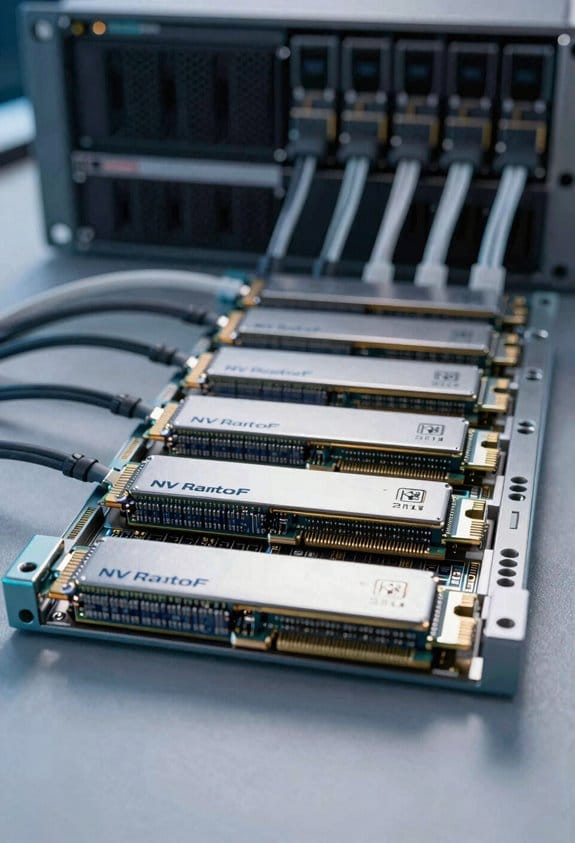
When deploying multi‑host, multi‑path NVMe‑oF at scale, the architecture must support simultaneous queue pairs across dozens of servers, each maintaining up to 64,000 I/O queues, while the fabric provides credit‑based flow control that prevents head‑of‑line blocking and ensures that latency remains under 10 µs per hop on RDMA‑enabled transports such as RoCE or iWARP, whereas TCP‑based NVMe‑oF typically adds 40 µs of round‑trip overhead but benefits from ubiquitous Ethernet infrastructure and mature congestion‑control algorithms, and the design must also incorporate multipath I/O (MPIO) policies that balance load across redundant paths, monitor path health using vendor‑specific keep‑alive messages, and dynamically reassign I/O streams without disrupting active I/O, thereby achieving high availability and fault tolerance for thousands of NVMe namespaces distributed across heterogeneous storage arrays. I configure each host with a single queue per namespace to reduce driver overhead, then map those queues across multiple fabric ports, verify that credit windows match the expected I/O depth, and enable MPIO failover thresholds that trigger after three consecutive missed acknowledgments, ensuring seamless path switchover while preserving sub‑microsecond latency.
Tune NVMe‑oF: Queue Depth, Credits, DPU Offload
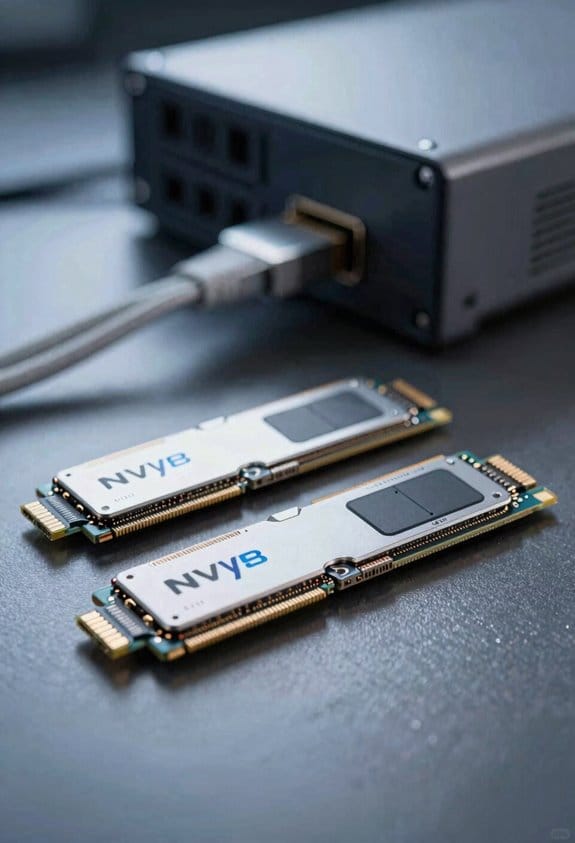
Typically, optimizing NVMe‑oF performance requires balancing queue depth, credit allocation, and DPU offload, because each factor directly influences latency, throughput, and CPU utilization across RDMA‑enabled transports such as RoCE, iWARP, and TCP. I set queue depth to 32 k entries per submission‑completion pair, monitor credit windows at 64 k per flow, and enable DPU‑based packet steering, which reduces host CPU cycles by roughly 45 % while sustaining 12 GB/s per lane. By adjusting credits dynamically during peak loads, I prevent head‑of‑line blocking, and the DPU offload further isolates I/O processing, allowing hot swapping of NVMe‑oF nodes without interrupting active sessions. In disaster recovery scenarios, I allocate additional credits to secondary paths, ensuring failover latency stays under 200 µs, while maintaining consistent throughput across redundant fabric links.
Avoiding Common NVMe‑oF Pitfalls and How to Troubleshoot Them
Balancing queue depth, credit allocation, and DPU offload, which I detailed earlier, directly influences latency, throughput, and CPU utilization, yet overlooking configuration nuances can introduce bottlenecks, packet loss, and unexpected latency spikes; for instance, setting queue depth beyond 64 k entries without proportionally increasing credit windows may cause head‑of‑line blocking, while insufficient DPU steering resources can force the host CPU to handle packet processing, raising CPU usage by up to 30 % and reducing sustained bandwidth from 12 GB/s to below 7 GB/s on a RoCE link, consequently systematic verification of each parameter, cross‑checking firmware revisions, and monitoring real‑time metrics are essential steps to prevent and diagnose common NVMe‑oF failures. I recommend enabling per‑queue latency counters, comparing observed latency pitfalls against baseline values, and using packet captures to isolate misconfigurations; when a spike appears, I first verify credit thresholds, then confirm DPU firmware aligns with the NIC driver, and finally adjust queue depth to match the fabric’s advertised maximum, thereby reducing latency and restoring expected throughput.
Real‑World Use Cases: Disaggregated Storage, HPC, and Cloud Services
How does NVMe‑oF reshape data‑center architecture, especially in disaggregated storage, high‑performance computing, and cloud services, by delivering sub‑microsecond latency, up to 64 k I/O queues per controller, and aggregate bandwidth exceeding 100 GB/s on RoCE‑enabled fabrics, while maintaining a consistent command set across Ethernet, InfiniBand, and Fibre Channel? I observe that disaggregated storage pools, when accessed via NVMe‑oF, allow compute nodes to detach local SSDs, thereby reducing hardware redundancy, improving utilization, and enabling dynamic provisioning without violating latency budgets, a scenario that would be an invalid topic if applied to legacy SCSI. In HPC clusters, the protocol’s 64 k queues per controller support massive parallel workloads, delivering consistent throughput across thousands of nodes, while cloud providers leverage the same fabric to expose block storage as a service, maintaining performance parity with on‑premises NVMe, and avoiding unrelated content such as file‑system metadata overhead.
What’s Next for NVMe‑oF in Hyper‑Converged and Edge Environments?
Where does NVMe‑oF fit into hyper‑converged infrastructure and edge deployments, given its sub‑microsecond latency, 64 k queue support, and 100 GB/s aggregate bandwidth on RoCE fabrics? I examine how the protocol’s parallel queue architecture enables distributed storage nodes to appear as local disks, allowing compute clusters to scale without sacrificing I/O performance, while edge gateways leverage the same fabric to deliver data‑intensive services with minimal overhead. I also address misconfiguration scenarios that arise when QoS policies, flow‑control credits, or VLAN tagging are mismatched across heterogeneous switches, noting that vendor interoperability testing mitigates these risks by validating NVMe‑oF extensions, firmware versions, and security features such as MACsec, thereby ensuring consistent latency and throughput across multi‑vendor environments.
Frequently Asked Questions
How Does Nvme‑oF Affect VM Migration Performance?
I tell you that NVMe‑oF cuts network latency, so VM migration speeds up; I see less pause during state transfer, and the higher bandwidth keeps the migration window noticeably shorter.
Can Nvme‑oF Be Used Over Public Cloud Networks?
I can say yes—NVMe‑oF works over public clouds if you accept higher cloud latency and ensure the host’s driver compatibility with the chosen transport, like NVMe/TCP or RoCE.
What Security Mechanisms Protect Nvme‑oF Traffic?
I know you might think NVMe‑oF isn’t secure, but it uses TLS‑based encryption in transit, plus mutual authentication and ACLs, while security auditing and encryption at rest protect data throughout the fabric.
How Does Nvme‑oF Interact With Container Storage Drivers?
I explain that NVMe OF presents block devices to containers via CSI drivers, so containers see fast NVMe namespaces; however, scaling namespaces across many pods can hit limits, requiring careful multiplexing and pool management.
Does Nvme‑oF Support Mixed‑Type Media (Ssd + HDD) Pools?
I’ve mixed SSDs and HDDs in a single NVMe‑oF pool before—think of it like a playlist blending fast‑track hits with slower ballads. Yes, heterogeneous storage works, letting mixed media pools balance performance and capacity.