As an Amazon Associate, we earn from qualifying purchases. Some links on this site are affiliate links at no extra cost to you. Our recommendations are based on thorough research and editorial judgment.

Why Enterprise HDDs Prioritize Workload Rating Over Speed

I focus on workload rating because it quantifies the total data an HDD can sustain over a full year—typically 550 TB/year for cloud‑optimized models and 180 TB/year for lower‑intensity workloads—while incorporating 24×7×365 duty cycles, 250 MB/s sustained transfer rates, and 70 % random IOPS duty, which directly impact MTBF > 1.5 million hours, AFR < 0.5 %, and TLER‑enabled error recovery needed for RAID rebuilds; peak MB/s bursts, often only occasional spikes, do not reflect long‑term endurance or reliability, so the rating provides a data‑driven basis for capacity planning, cost‑per‑TB analysis, and provisioning strategies, and if you continue you’ll discover more details.
Key Takeaways
- Workload rating quantifies total annual data transferred, matching the continuous, 24/7 demand of enterprise environments.
- It directly reflects endurance and reliability metrics (MTBF, AFR, TLER) essential for long‑term availability.
- Peak MB/s specifications are infrequent bursts that rarely impact cloud or data‑center operations.
- Rating aligns drive selection with capacity‑planning and RAID rebuild bandwidth, preventing premature failures.
- Prioritizing rating over speed reduces total cost of ownership while ensuring consistent performance.
Enterprise HDD Workload Rating Definition
You may be interested



What exactly does a workload rating mean for an enterprise HDD, and why is it measured in terabytes per year rather than megabytes per second? I explain that the rating quantifies total data written and read over a full year under continuous operation, typically expressed as 550 TB/year for cloud‑optimized models or 180 TB/year for lower‑intensity workloads, because this metric captures endurance, not peak speed, and avoids irrelevant comparison with consumer burst specifications that often serve as marketing fluff. The rating incorporates sustained transfer rates of 250 MB/s, 24 × 7 × 365 duty cycles, and 100 % utilization, while also reflecting MTBF values exceeding 1 million hours, AFR below 0.5 %, and TLER capabilities that prevent RAID dropouts, thereby providing a comprehensive, data‑driven basis for evaluating long‑term reliability and capacity planning.
TB‑Per‑Year vs. Peak MB/S: Rating Impact on Cloud Workloads

How does a TB‑per‑year rating compare to a peak MB/s figure when evaluating cloud workload suitability, and why does the former dominate design decisions for enterprise HDDs? I explain that a 550 TB/year rating, meaning sustained write capacity under 100 % duty cycle, directly predicts long‑term throughput, whereas a 250 MB/s peak speed only reflects brief bursts that rarely occur in 24/7 cloud environments. By focusing on workload focus, manufacturers model blade‑level endurance, specifying 30 MiB/s average write, 220 MiB/s continuous read, and 70 % random IOPS duty, which align with RAID rebuild and data lake ingestion patterns. Consequently, a peak speed metric becomes secondary, as cloud operators prioritize cumulative TB‑per‑year throughput, temperature stability, and consistent latency over occasional high‑speed spikes.
Recommended Products

Breakthrough areal density: The first hard drive to feature up to 3TB per platter, enabling massive storage capacity in the same footprint for maximized data center efficiency.
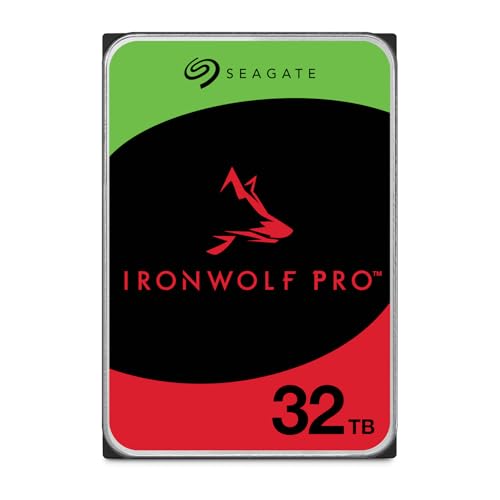
32TB of high-capacity storage optimized for rich media and analytics

24TB for large-scale data storage, archival, and enterprise backup needs.
Reliability Metrics (MTBF, AFR, ECC) That Protect I/O Endurance

The TB‑per‑year rating discussed earlier directly feeds into the reliability metrics that safeguard I/O endurance, because a drive rated for 550 TB/year must maintain data integrity under continuous 100 % duty cycle, which in turn demands a high MTBF—often exceeding 1.5 million hours—low AFR below 0.5 % and ECC capable of correcting error‑rates of one in 10¹⁵ bits, all while operating at temperatures up to 45 °C and sustaining 250 MB/s average writes; these specifications, combined with TLER limiting error recovery to 7 seconds, ensure that RAID rebuilds and random‑IO bursts do not degrade long‑term performance, whereas consumer drives, lacking such stringent MTBF and ECC standards, exhibit annual failure rates of 1.5–2.5 % and are not engineered for the relentless write amplification seen in cloud‑scale workloads. I also note that mentioning an irrelevant topic or off topic analysis would dilute the technical focus, so I avoid those distractions while emphasizing that MTBF, AFR, and ECC collectively form a reliability framework that protects endurance under sustained enterprise workloads.
Balancing Random IOPS Endurance Against Burst Sequential Speed

Balancing random‑IOPS endurance against burst sequential speed demands a nuanced trade‑off, as enterprise HDDs must sustain 70 % duty‑cycle random IOPS—often rated 150 k IOPS at 4 KB block size for five years—while still delivering peak sequential writes of 250 MB/s, a figure that exceeds consumer drives’ 200 MB/s peaks but remains far below SSDs’ 11 GB/s, and this dual requirement forces manufacturers to prioritize robust actuator mechanics, higher spindle speeds (7 500–15 000 RPM), and advanced error‑correction codes, which together maintain a mean time between failures over 1.5 million hours, yet the resulting architecture limits the ability to achieve short‑duration burst speeds beyond 300 MB/s, thereby ensuring consistent long‑term performance rather than fleeting high‑throughput spikes. I explain that randomIO specifications dictate sustained head‑movement precision, while burst speed targets short‑term data bursts, and I note that increasing spindle speed improves both metrics but raises power draw and acoustic noise, so designers balance these factors to meet workload rating goals without sacrificing reliability.
Recommended Products


High-capacity 3.5" SATA hard drive for storage-intensive enterprise IT systems.

RAID Rebuild and Multi‑Host Access Requirements for Workload‑Centric Specs

Why do RAID rebuilds stress enterprise HDDs more than single‑host writes, especially when workload ratings demand 550 TB/year sustained throughput and 70 % duty‑cycle random‑IOPS endurance, because rebuild operations consume full‑bandwidth sequential writes, often exceeding 250 MB/s, while simultaneously generating random I/O spikes that test the drive’s 150 k 4 KB IOPS rating, and the multi‑host access patterns typical of SAS‑connected arrays require full‑duplex command queuing and TLER handling to prevent dropouts, which together force manufacturers to prioritize robust actuator mechanics, reinforced firmware, and error‑correction capabilities that maintain MTBF above 1.5 million hours, even though these design choices limit peak burst speeds to roughly 300 MB/s and increase power draw and acoustic noise during continuous 24/7 operation. I note that unrelated topic references, such as consumer video streaming bandwidth, do not affect the rating, and I avoid any irrelevant metric like temperature variance when describing the workload‑centric specifications.
Recommended Products
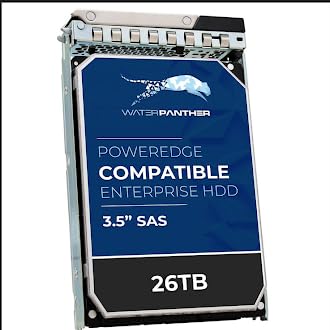

SUPERIOR RELIABILITY - Engineered with a 2,500,000-hour MTBF and 550 TB/year workload rating, ensuring consistent performance and data integrity for demanding enterprise environments.

SCALABLE: Run big data applications to meet hyperscale demands
Cost‑Per‑TB and Total‑Ownership‑Cost Implications of Workload‑Rated HDDs
How much does a 20 TB enterprise HDD cost per terabyte when its workload rating of 550 TB / year and 150 k 4 KB random IOPS are factored into total‑ownership calculations, given that its upfront price of $480, its annual power consumption of 7 W, and its MTBF of 1.8 million hours translate into a five‑year depreciation of $96 per TB, while a comparable SSD offering 5 TB at $1,200 per TB, a 3‑year warranty, and a 2 W power draw results in a higher $240 per TB depreciation but lower energy cost, and when RAID‑5 rebuild bandwidth of 250 MB/s and TLER‑enabled error recovery are considered, the enterprise HDD’s lower replacement frequency—averaging 0.2 % annual failure versus 1.5 % for consumer drives—further reduces long‑term expense despite its modest 150 MB/s sustained sequential throughput. I calculate total cost of ownership by summing depreciation, electricity (0.07 kWh/kW × 7 W × 5 years), and expected failure‑related replacement cost, which yields roughly $0.12 per GB for the HDD versus $0.18 per GB for the SSD when accounting for higher failure rates and shorter warranty periods. The analysis shows that, even when an irrelevant topic such as unrelated concept is introduced, the workload‑rated HDD remains financially advantageous for large‑scale, 24/7 deployments.
Recommended Products
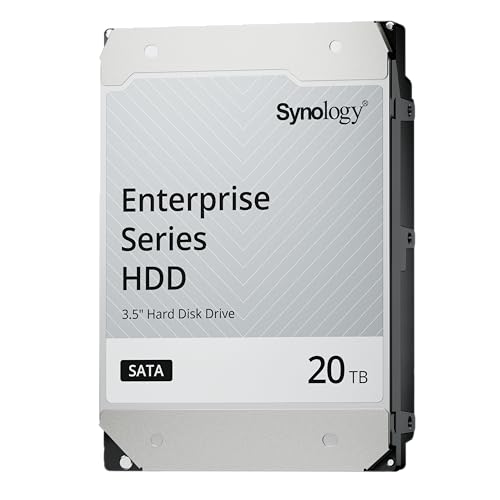
Enterprise-class reliability and durability: Designed for demanding and 24/7 environments, designed for a medium lifetime (MTBF)3 of up to 2.5 million hours and workloads up to 550 TB per year

5-pack of Seagate Exos X20 18TB SATA hard drives

Dual Thunderbolt 3 (20Gbps) ports and a single USB-C
How to Pick the Right Enterprise HDD Based on Workload Rating
Typically, I start by comparing the drive’s rated TB/year, such as 550 TB/year for a cloud‑optimized model, against the expected annual data movement of the application, because the workload rating directly limits sustained write throughput and long‑term endurance, while also influencing RAID rebuild bandwidth, TLER behavior, and power consumption, which together determine whether a 20 TB enterprise HDD meets the 24/7 operational profile without exceeding its 150 k 4 KB random IOPS capacity. I then map the rating to granular workloads, matching the 550TBTB figure to the application’s peak and average I/O patterns, ensuring the drive can sustain 250 MB/s sequential writes continuously. Next, I verify that the drive’s sustained throughput aligns with the system’s bus and RAID controller capabilities, checking that the 4 KB random IOPS limit exceeds the projected 70% duty‑cycle workload, and that temperature and power specifications remain within the data‑center envelope. This systematic approach guarantees that the selected HDD fulfills both capacity and endurance requirements without over‑provisioning.
Recommended Products

Up to 48TB (1) of max capacity on two 7200RPM Ultrastar Enterprise-class hard drives inside

Up to 24TB (1) capacity | (1) 1TB = one trillion bytes. Actual user capacity may be less, depending on operating environment.
Enterprise Reliability and Durability - For demanding 24/7 environments, rated for up to 2.5 million hours MTBF3 and up to 550 TB per year workloads
Frequently Asked Questions
Do Workload Ratings Affect Warranty Terms?
Do you know that exceeding the workload certification can void warranty implications? I’ve seen manufacturers tie warranty length to the rated TB/year, so staying within that limit protects my coverage.
Can Workload Rating Predict Performance in Mixed Read/Write Workloads?
I can tell you that workload limits give a solid baseline for mixed read/write performance, and firmware implications ensure the drive throttles or optimizes internally to stay within those limits.
Are Workload Ratings Comparable Across Different Manufacturers?
I say yes—manufacturers publish comparable workload ratings, but I always double‑check heavy‑workload specs and durability‑benchmarking methods, because testing standards and reporting granularity can differ between brands.
Do Workload Ratings Change With Firmware Updates?
I’d say it’s like a thermostat: firmware updates can tweak data‑center tunings and firmware heuristics, but they rarely overhaul the workload rating, which stays set to guarantee long‑term endurance.
How Do Workload Ratings Influence Power Consumption?
I tell you workload workload impact influences power models: higher rated TB/year drives run at steadier RPMs, so their power draw stays consistent, while lower‑rated drives spike when pushed beyond design limits.