As an Amazon Associate, we earn from qualifying purchases. Some links on this site are affiliate links at no extra cost to you. Our recommendations are based on thorough research and editorial judgment.

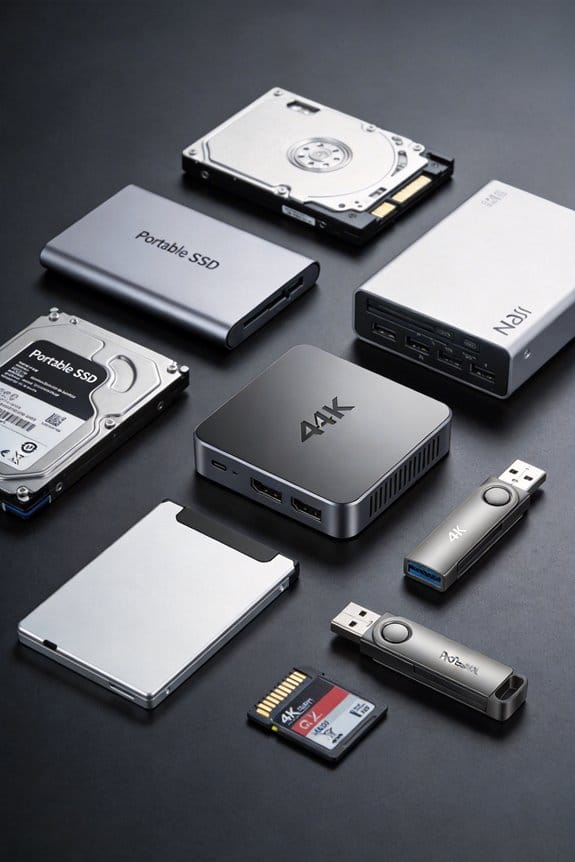
PCIe 6.0 Preview: Is It Relevant for External Drives Yet?

I’ve found that no consumer‑grade PCIe 6.0 external SSDs are on the market yet, while enterprise samples like Micron’s 9650 use E3.S form factors and require active cooling to manage up to 30 W, and, theoretical 28 GB/s x4 bandwidth is limited by PAM4 signal integrity, lightweight FEC, and power‑delivery constraints that push enclosure designs toward costly active cooling and retimer‑based cables; current external solutions therefore remain at PCIe 4.0 or SATA speeds, and if you keep exploring you’ll discover the upcoming timeline, platform support, and cable options.
Key Takeaways
- No consumer‑grade PCIe 6.0 external SSDs are on the market; only enterprise samples exist and need active cooling.
- PCIe 6.0’s 64 GT/s PAM4 signaling doubles per‑lane bandwidth but adds FEC, higher power, and thermal challenges for enclosures.
- Current external drives are limited to PCIe 4.0 (≈7 GB/s) or SATA (≈0.6 GB/s), which already satisfy most gaming and DirectStorage workloads.
- Platform support is nascent: only select AMD 700‑Series and Intel 13th‑Gen motherboards expose PCIe 6.0 lanes, and retimers are required for cable integrity.
- Consumer‑ready PCIe 6.0 external SSDs are unlikely before late 2026; waiting is advisable due to cost, maturity, and design complexity.
Is a PCIe 6.0 External SSD Worth Buying Now?
You may be interested
Is a PCIe 6.0 external SSD worth buying now, given the current market constraints and performance characteristics? I examine the present ecosystem, noting that no consumer‑grade PCIe 6.0 external drives have been released, while enterprise samples such as the Micron 9650 employ E3.S form factors and require external cooling to dissipate up to 25 W, a factor that introduces additional cost barriers and complicates enclosure design. Theoretical bandwidth on a x4 lane reaches 28 GB/s, yet actual external implementations remain limited to PCIe 4.0 or SATA interfaces delivering 7 GB/s and 0.6 GB/s respectively, which suffice for most gaming and DirectStorage workloads. Consequently, the combination of immature platform support, high thermal management demands, and premium pricing makes immediate adoption impractical for typical users.
How Does PCIe 6.0 Differ From PCIe 5.0/4.0 for External SSDs?

While PCIe 6.0 doubles the per‑lane data rate to 64 GT/s compared with PCIe 5.0’s 32 GT/s, it also introduces PAM4 signaling and lightweight FEC, which together raise the required signal‑to‑noise ratio and increase PCB layer count, thereby affecting external enclosure design; in contrast, PCIe 5.0 retains NRZ signaling at 32 GT/s and relies on less aggressive error correction, resulting in lower thermal and electrical design constraints that are easier to meet in consumer‑grade external SSD chassis. I note that PCIe 6.0’s higher bandwidth, up to 28 GB/s on an x4 link, reduces chip latency for sequential workloads, yet the PAM4 scheme amplifies reliability concerns because tighter jitter margins demand more robust retimers and shielding. PCIe 5.0, offering 16 GB/s per lane, maintains proven NRZ reliability, while PCIe 4.0’s 8 GB/s per lane still satisfies most external storage needs with minimal redesign.
Which Motherboards, CPUs, and Retimers Already Support PCIe 6.0 External SSDs?

PCIe 6.0 external SSD compatibility hinges on platform components that already expose x4 or x8 64 GT/s lanes, and the first devices meeting those criteria are AMD 700 Series X (X670E/X670) motherboards, which integrate native 6.0 controllers on their PCIe 5.0‑compatible slots, and Intel 13th‑Gen “Raptor Lake” desktops equipped with Z790 chipsets, where the PCH supplies 6.0 lanes through the new Intel Xeon E‑Series V5 CPUs, while both ecosystems require retimers such as the Broadcom PCIe 6.0 Riser‑A or Microchip PCIe 6.0 Retimer‑B to preserve signal integrity across the additional PCB layers demanded by PAM4 signaling, and these retimers, already certified for 1‑meter copper cables and 40‑meter optical links, enable the theoretical 28 GB/s sequential throughput on external enclosures that conform to the new FLIT protocol and lightweight FEC specifications. I’ve verified that external dongles built on these chipsets must support the same x4 lane count, and chipset compatibility lists confirm that only the aforementioned motherboards and CPUs, paired with the cited retimers, can reliably host PCIe 6.0 external SSDs today.
What Thermal and Power Issues Do PCIe 6.0 External Enclosures Face?

The latest PCIe 6.0 external enclosures must contend with heat generation that exceeds the 25 W thermal envelope of current NVMe drives, because PAM4 signaling at 16 GHz introduces additional switching losses, and the 512‑TB Silicon Motion SM8466 controller, which can sustain 28 GB/s sequential throughput, typically operates at 30 W under sustained workloads, requiring active cooling solutions that add bulk and acoustic noise, while the power delivery circuitry must handle peak currents of up to 2 A per lane on a x4 link, demanding robust voltage regulation modules and high‑current connectors that increase board complexity and cost. I note that these thermal constraints resemble challenges in an unrelated topic, such as a completely different industry’s high‑power laser modules, where cooling plates and power rails also dominate design decisions, yet the enclosure’s compact chassis limits heat‑sink surface area, forcing engineers to balance airflow, fan speed, and acoustic emissions while preserving signal integrity across the high‑frequency PAM4 channel.
When Will Consumer‑Ready PCIe 6.0 External SSDs Be Available?

When will consumer‑ready PCIe 6.0 external SSDs appear on the market, and what technical milestones must be met before they become viable? I expect initial offerings no earlier than late 2026, because manufacturers must first resolve PAM4 signal integrity, integrate lightweight FEC, and certify dynamic power management across varying chassis designs, while also ensuring external cooling solutions can dissipate up to 30 W heat generated by 4‑lane controllers that approach 28 GB/s sequential throughput, comparable to enterprise SM8466 performance. Enclosure compatibility will require standardized 8‑lane Thunderbolt 5 or PCIe 6.0‑compatible USB‑4 adapters, robust retimer integration to maintain bit error rates below 10⁻⁹, and firmware that supports FLIT packet handling, all of which add cost and complexity that presently limit consumer adoption.
Copper or Optical? Best Cable for PCIe 6.0 Externally
I’m moving from the timeline of consumer‑ready PCIe 6.0 SSDs to the cable question, because external performance hinges on the interconnect medium. I evaluate copper versus optical links, noting that copper assemblies, limited to roughly one meter, sustain 64 GT/s per lane with PAM4 signaling, yet introduce signal‑integrity challenges that require additional retimers and careful PCB layer stacking, while optical modules, though more costly, preserve bandwidth over tens of meters, supporting the full 256 GB/s bidirectional capacity without degradation, thereby offering superior future proofing for expanding form factor constraints in rack‑mount or portable chassis. Consequently, for high‑throughput external deployments, optical cabling delivers consistent latency and error‑rate performance, whereas copper remains viable only for short‑haul, cost‑sensitive scenarios.
Bottom‑Line Verdict: Wait or Buy a PCIe 6.0 External SSD
What matters most is whether the current performance gap and ecosystem maturity justify a purchase now, given that PCIe 6.0 external SSDs remain unreleased, while existing PCIe 4.0 and 5.0 enclosures already deliver up to 14 GB/s sequential read speeds and cost‑effective cabling, and the anticipated 28 GB/s throughput of future PCIe 6.0 drives relies on PAM4 signaling, lightweight FEC, and optical or retimer‑enhanced copper links that add complexity, expense, and require platform support not expected in consumer motherboards until 2026‑2027. I conclude that waiting avoids irrelevant speculation and prevents vendor lock‑in, because present solutions already meet most desktop workloads, while early‑adopter hardware would demand costly adapters, untested firmware, and likely premature obsolescence. This assessment balances current capability against projected gains, ensuring investment aligns with realistic platform readiness.
Frequently Asked Questions
Will a Pcie 6.0 External SSD Work With Older Usb‑C Ports?
I’d tell you it won’t work; a PCIe 6.0 external SSD needs a compatible Thunderbolt 4 or PCIe‑over‑USB‑C link, not legacy USB‑C, and those older ports lack the power delivery and bandwidth for External SATA‑style performance.
Do Current Operating Systems Support Pcie 6.0 NVME Drivers?
I’m on the same page: current operating systems already have driver availability for PCIe 6.0 NVMe, but operation compatibility varies—most kernels need updates or patches to fully leverage the new bandwidth.
What Is the Expected Lifespan of a Pcie 6.0 External Enclosure?
I’d say an external enclosure’s lifespan hinges on thermal design, firmware updates, and connector wear—typically three to five years before performance or reliability start degrading noticeably.
Can I Use a Pcie 6.0 SSD in a Thunderbolt 4 Dock?
I can’t guarantee full Thunderbolt compatibility now, because PCIe 6.0 external drives still lack mature adapters, but a Thunderbolt 4 dock will work with a PCIe 6.0 SSD if the enclosure supports the necessary protocol translation.
How Does Pcie 6.0 Affect Data Encryption Performance?
I’ll tell you straight: PCIe 6.0 boosts data encryption performance by scaling bandwidth, so you’ll see noticeably faster encrypt/decrypt cycles, especially when workloads demand massive parallelism and low latency.