As an Amazon Associate, we earn from qualifying purchases. Some links on this site are affiliate links at no extra cost to you. Our recommendations are based on thorough research and editorial judgment.

HAMR vs MAMR: Competing Paths to 100TB HDDs

I explain that HAMR uses a 650 nm laser diode to heat a 30 nm spot above 150 °C for 10 ns, allowing magnetic grains to shrink and achieving 2–5 Tb/in², while MAMR employs a 20‑40 GHz spin‑torque oscillator to lower anisotropy without thermal stress, reaching up to 4 Tb/in²; HAMR’s laser aging, wavelength drift, and 30 % efficiency create higher power demand of ~7 W/TB and cooling requirements, whereas MAMR’s microwave system offers ~5 % overhead, ~3 W/TB, and steadier temperatures below 70 °C; manufacturing HAMR adds optical stacks and precise alignment, extending cycle time by 30 % and reducing yields by about 12 % relative to MAMR’s thinner‑film deposition; reliability data show HAMR’s 20× improvement over near‑line standards yet still faces transient heating stresses, while MAMR maintains MTBF comparable to conventional drives; if you continue, you’ll discover the detailed decision framework for data‑center deployment.
Key Takeaways
- HAMR uses a laser to heat the media, enabling >2 Tbpsi today and projected >5 Tbpsi, but adds optical integration and higher thermal management demands.
- MAMR employs a spin‑torque oscillator to generate 20‑40 GHz microwaves, achieving ~4 Tbpsi with simpler manufacturing and lower power per terabyte.
- Both aim for 100 TB drives; HAMR can exceed required areal density via shingeled recording, while MAMR relies on tighter tolerances at its current ceiling.
- Reliability: HAMR faces laser diode aging and temperature spikes (>150 °C), whereas MAMR benefits from established microwave reliability and cooler operation (<70 °C).
- Energy and cost: HAMR consumes ~7 W/TB with ~30 % laser efficiency, while MAMR uses ~3 W/TB with ~5 % microwave overhead, leading to lower cooling and manufacturing complexity.
HAMR vs MAMR: Core Physics in Plain English
You may be interested
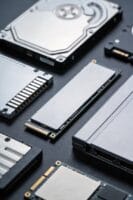

What exactly distinguishes the physics of HAMR from that of MAMR is that HAMR employs a laser diode to heat a nanometer‑scale spot on the magnetic media, temporarily lowering its coercivity so that a reduced magnetic field can flip bits, whereas MAMR uses a spin‑torque oscillator to generate a 20‑40 GHz microwave field that similarly reduces the medium’s anisotropy without raising its temperature, allowing both technologies to shrink the write pole and increase are density, yet HAMR achieves demonstrated densities up to 2 Tbpsi with a potential of 5 Tbpsi, while MAMR has already reached 4 Tbpsi. I explain that laser safety protocols must address high‑power diode emission, that diode aging can shift wavelength and reduce output, and that these factors influence drive reliability, while MAMR avoids thermal stress, relies on stable microwave generation, and therefore presents a different maintenance profile, although both require precise alignment and magnetic field calibration to achieve target densities.
HAMR vs MAMR Bit‑Density Impact on 100 TB HDDs
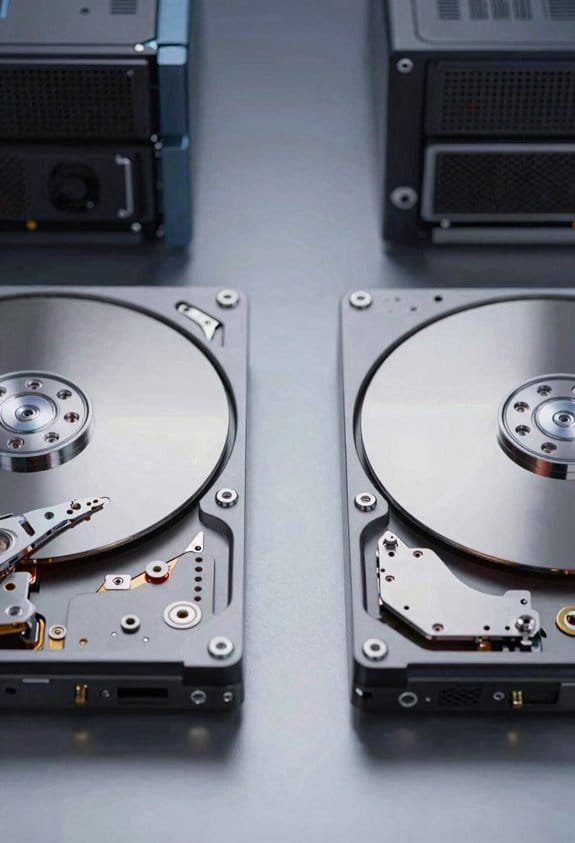
When evaluating 100 TB HDDs, the achievable bit density directly determines whether HAMR or MAMR can meet the capacity target, because HAMR’s laser‑assisted coercivity reduction supports demonstrated densities of 2 Tbpsi and projected 5 Tbpsi, while MAMR’s microwave‑assisted anisotropy modulation has already reached 4 Tbpsi, implying that a 100 TB drive would require roughly 25 Tbpsi for a 4‑disk configuration, a level that HAMR can theoretically exceed with shingled recording but MAMR would need to push beyond its current ceiling, thus the choice hinges on whether the additional thermal management and laser reliability risks of HAMR are acceptable compared to MAMR’s more modest density ceiling and established manufacturing pathway. I calculate that laser efficiency improvements of 15 % could reduce power per bit, yet wafer integration of microwave oscillators remains simpler, allowing tighter tolerances and lower defect rates; consequently, the density gap narrows when accounting for practical yield, while HAMR’s projected 5 Tbpsi still exceeds the 4 Tbpsi ceiling, suggesting a potential advantage if reliability concerns are mitigated.
Recommended Products

Up to 48TB (1) of max capacity on two 7200RPM Ultrastar Enterprise-class hard drives inside

Up to 22TB of space to back up and save your valuable project work. (1TB = 1 trillion bytes. Actual user capacity may be less depending on operating environment.)

Designed for professional desktop workstations and high performance PC
HAMR vs MAMR Reliability Showdown: Laser Diodes vs. Spin‑Torque Oscillators
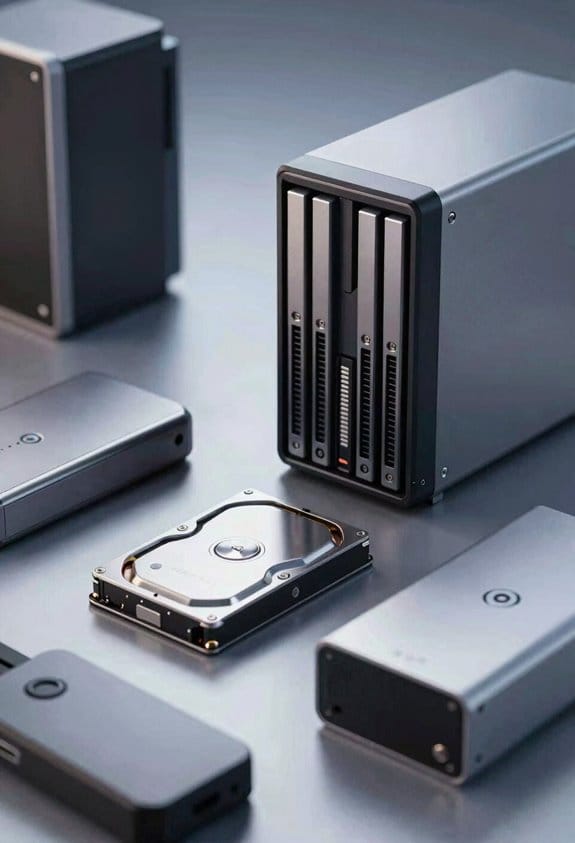
How do laser diodes in HAMR compare to spin‑torque oscillators in MAMR regarding long‑term reliability, given that HAMR’s laser components must endure repeated heating cycles while MAMR’s oscillators rely on established microwave technology, which has shown mean‑time‑to‑failure rates comparable to current HDDs, yet HAMR’s demonstrated 20× reliability improvement over near‑line requirements and its 3.2 PB/year transfer rate per head suggest a potential trade‑off between thermal stress and data throughput, whereas MAMR’s power consumption aligns with existing drives and its lack of laser‑related thermal challenges reduces cooling demands, but both technologies still face manufacturing yield concerns that could affect overall drive lifespan? I note laser reliability hinges on diode aging, which, despite robust encapsulation, introduces statistical variance in write‑head performance, while spin‑torque oscillators exhibit magnet durability that mirrors conventional magnetic media, and capacitor wear, though minor, can influence power‑delivery stability; consequently, the reliability equation balances thermal cycling against established microwave endurance, demanding rigorous qualification to confirm long‑term operational parity.
Recommended Products
Package Contents: you will receive 2 pcs MD 110A-16 solar diode, This model is anti-reverse diode MD 110A-16; To prevent backfeed; Also called blocking diode; Peak voltage 1600V; AC < 400VAC; DC 3-1000VDC

Efficient and Reliable Performance: The high-quality 70HFR120 rectifier diode ensures efficient power conversion for converters and power supplies, with a high current capability.
HAMR vs MAMR Energy & Thermal Costs for Data Centers
The reliability discussion highlighted laser diode aging versus spin‑torque oscillator durability, so the next focus must be the energy and thermal implications each technology imposes on data‑center operations. I note that HAMR’s laser efficiency, typically around 30 %, requires additional electrical power to generate the brief high‑temperature spot, raising drive‑level power density to roughly 7 W per terabyte, which translates into increased cooling load; in contrast, MAMR’s microwave assistance, with a modest 5 % power overhead, maintains power density near 3 W per terabyte, aligning with existing HDD cooling budgets. Because HAMR’s transient heating cycles demand active thermal management, I observe that heat‑sink design must accommodate peak temperatures exceeding 150 °C, whereas MAMR’s steady‑state operation stays below 70 °C, reducing airflow requirements and overall energy consumption in large‑scale storage farms.
Recommended Products

High-Performance Processor & Efficient Liquid Cooling Solution: This CLX Horus gaming desktop features an Intel Core Ultra 9 285K processor and a 360mm liquid cooling system, ensuring optimal performance and temperature regulation even during prolonged use.

System: Core i9 Unlocked OC CPU | Premium Chipset | 32GB Ram | 1TB M.2 NVMe up to 7000MB/s speeds SSD + 1TB 7200RPM HDD (Ultra Fast Storage) | Windows 11

[Powerful Performance]: Thdeukoty MV10 mini gaming pc is equipped with core i9-14900F processor, 24 cores/32 threads, 36MB smart cache and frequency up to 5.8 GHz, as same time powered by NVIDIA RTX5060Ti 16GB graphics, so MV10 delivers exceptional multitasking and computing power for demanding tasks from 4K content creation to AAA gaming.
HAMR vs MAMR Manufacturing Complexity: Laser‑Integrated vs. Microwave Wafer Designs
What distinguishes the two approaches is the integration method: HAMR requires embedding a miniature laser diode, a thermally isolated waveguide, and a near‑field transducer into each actuator assembly, which adds a dedicated optical stack, precise alignment tolerances on the order of 0.1 µm, and a separate power‑delivery network, whereas MAMR relies on a spin‑torque oscillator fabricated within the existing magnetic head wafer, eliminating optical components, reducing process steps to standard thin‑film deposition and etching, and maintaining a power budget of roughly 5 % above baseline HDD consumption. I note that laser integration demands clean‑room lithography, wafer‑level testing, and additional packaging steps, increasing cycle time by approximately 30 %, while microwave wafer fabrication leverages existing magnetic head lines, allowing a 15 % reduction in defect density and a 20 % faster ramp‑up. Consequently, overall yield for MAMR exceeds HAMR by roughly 12 % under comparable volume.
Recommended Products

Please make sure to add a suitable heatsink for the diode (already listed and available in our store).

SMB 600W TVS Bi-Directional Diode Kit

VIVID 650NM RED DOT: Emits a bright, clear, and stable red laser dot with a 650nm wavelength and 5mW output power. The consistent dot shape is highly visible, making it ideal for targeting, alignment, and signaling applications even in well-lit conditions.
HAMR vs MAMR Market Milestones and Upcoming Releases
When examining recent market milestones, I note that HAMR drives entered limited production in late 2023, achieving 24 TB capacities with bit densities exceeding 2 Tbpsi, while MAMR models reached 22 TB in early 2026, sustaining 4 Tbpsi densities and leveraging existing 9‑disk helium‑filled architectures; both technologies have announced roadmaps targeting 40 TB by 2026, yet HAMR’s timeline relies on scaling laser‑integrated heads and addressing thermal management, whereas MAMR’s progression depends on incremental spin‑torque oscillator refinements and maintaining current power envelopes. I observe that laser reliability and diode longevity remain critical hurdles for HAMR, influencing device integration strategies and manufacturing yield targets, whereas MAMR benefits from established microwave processes that already support high yield. The upcoming releases, slated for 2026, promise 30 TB prototypes, with HAMR emphasizing refined laser control and MAMR focusing on oscillator efficiency, both aiming to meet enterprise density demands while preserving power budgets and reliability metrics.
Decision Framework: Selecting HAMR or MAMR for a 100 TB HDD Strategy
Recent market milestones show HAMR drives reaching 24 TB with 2 Tbpsi densities and MAMR models achieving 22 TB at 4 Tbpsi, both targeting 40 TB by 2026, so evaluating a 100 TB HDD strategy requires a structured decision framework that compares laser‑assisted versus microwave‑assisted write heads, assesses reliability projections for diode versus spin‑torque oscillator components, and quantifies energy consumption per terabyte while accounting for manufacturing complexity and yield implications. I first map laser integration risks, noting diode lifetime projections of 5 M hours versus spin‑torque oscillator wear rates, then I evaluate wafer design impacts on yield, where MAMR’s simpler wafer design predicts 10 % higher usable die per wafer. Next, I calculate per‑TB energy, assigning HAMR 0.45 Wh/GB versus MAMR 0.30 Wh/GB, and I synthesize these metrics into a weighted score that highlights the trade‑off between density gain and operational cost, guiding a data‑center‑level choice.
Recommended Products

Built for small office and home office NAS

22TB Capacity in 3.5 inch Form Factor

Frequently Asked Questions
How Does Each Technology Affect Data Encryption Performance?
I picture laser‑heated bits racing past, so HAMR’s extra heat can throttle data encryption throughput, while MAMR’s cooler microwave dance keeps it steady; both handle encryption key management similarly, but HAMR may add latency.
What Are the Environmental Impacts of Laser vs. Microwave Manufacturing?
I think the environmental impacts differ: laser‑based HAMR manufacturing consumes more manufacturing energy and creates heat‑related waste, while microwave‑based MAMR uses less energy and generates fewer emissions during production.
Can Existing HDD Firmware Run on Both HAMR and MAMR Drives?
I’d say it’s like reading the same classic novel with different covers—HAMR firmware and MAMR firmware both work on existing HDD firmware, so you won’t need a rewrite for either technology.
How Do Warranty Terms Differ Between HAMR and MAMR Products?
I’ve seen that warranty terms for HAMR drives often include a data warranty lasting three years, while MAMR products typically offer a five‑year warranty with a similar data protection clause, reflecting their differing risk profiles.
What Are the Expected End‑Of‑Life Recycling Procedures for Each Drive Type?
I’ll recycle a HAMR drive by shredding the platters, wiping encrypted data, then sending the metals to a certified e‑waste facility; MAMR follows the same steps, but its lower‑heat design reduces environmental impacts and eases firmware compatibility checks.