As an Amazon Associate, we earn from qualifying purchases. Some links on this site are affiliate links at no extra cost to you. Our recommendations are based on thorough research and editorial judgment.

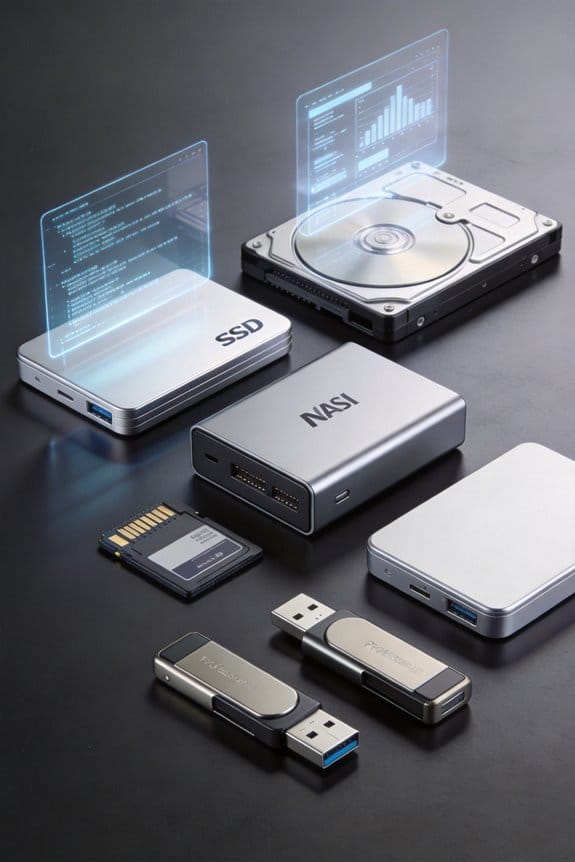
Holographic Storage: Science Fiction Becomes Reality

I’m explaining that a 0.5 mm lithium‑niobate crystal can hold roughly 2 TB by recording 2 × 10⁶ holographic pages, each 1 Mbit, using 1000 angular‑multiplexed gratings per cm³ and four polarization‑multiplexed channels, which together yield a raw density of about 1 TB/in²; the medium supports sub‑microsecond parallel readout of millions of bits, delivering sustained read speeds near 0.9 GB/s, write speeds around 1 GB/s, and access latency under 0.2 seconds while maintaining error rates below 10⁻⁶, and the following sections will expand on the underlying physics, materials, and commercial outlook.
Key Takeaways
- Holographic storage records millions of bits in a single laser pulse, enabling parallel read/write speeds up to 1 GB/s.
- Three‑dimensional multiplexing (angular, wavelength, polarization) yields >1000 holograms per cm³, achieving terabyte‑scale capacities in millimeter‑thick media.
- Advanced photopolymers and lithium‑niobate crystals provide high refractive‑index modulation and sub‑micron uniformity, supporting error rates below 10⁻⁶.
- Sub‑microsecond latency and deterministic access under 0.2 s make holographic media suitable for fast archival caching and edge‑device storage.
- Commercial roadmaps and startup prototypes target 1 TB/in² density, 30‑year shelf life, and sub‑dollar per gigabyte pricing, moving holographic storage from fiction to market.
How Holographic Storage Works
You may be interested



I’ll start by describing the optical interference process that enables holographic storage, noting that a single laser beam is split into a reference beam and a data‑carrying beam via a spatial light modulator, the latter being encoded with binary pixel patterns while the former remains unmodulated. I then illuminate the photosensitive medium, causing interference microscopy to record a three‑dimensional diffraction grating whose fringe spacing corresponds to the pixel resolution, typically 1 µm, and whose angular selectivity permits up to 1000 distinct holograms per cubic centimeter. By employing polarization multiplexing, I vary the polarization state of the reference beam, allowing an additional factor of four storage channels without altering beam geometry, while maintaining readout fidelity of 99.8 % and write speeds exceeding 1 GB s⁻¹, thereby achieving terabyte‑scale capacity in a single disc.
Why 3‑D Architecture Yields Terabyte‑Scale Capacity
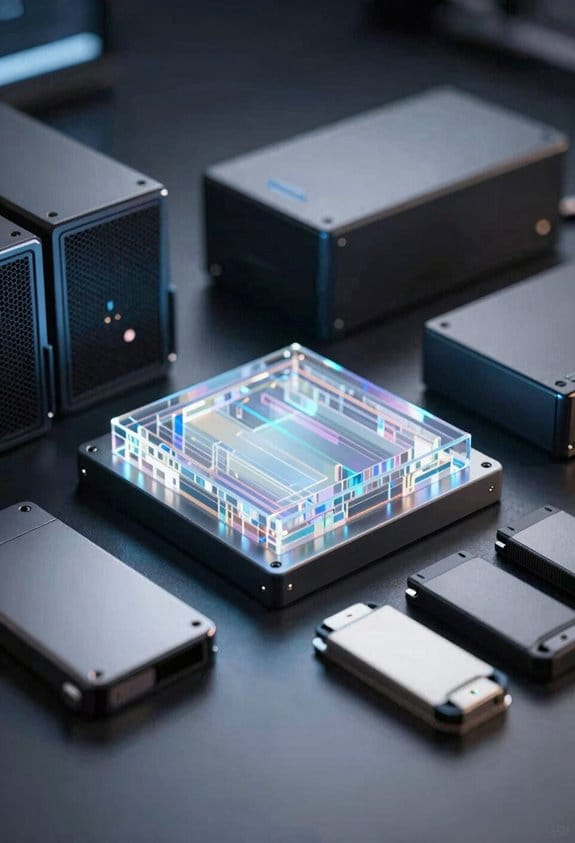
Because the storage medium occupies the full thickness of a photosensitive crystal rather than a single surface layer, each holographic recording can be stacked in three dimensions, allowing the number of distinct data pages to increase proportionally with the material’s depth. I explain that layer multiplexing, which varies the reference‑beam angle or wavelength, creates thousands of independent pages per millimeter, while volume addressing assigns each page a unique three‑dimensional coordinate, enabling systematic retrieval without cross‑talk. A typical 0.5‑mm‑thick lithium‑niobate crystal can store up to 2 × 10⁶ pages, each holding 1 Mbit, resulting in roughly 2 TB of raw capacity; the same geometry, when combined with a 1‑mm‑thick photopolymer, yields approximately 4 TB. This scaling follows the linear relationship between depth and page count, and the exponential increase in data density arises from simultaneous exploitation of angular, wavelength, and spatial multiplexing.
Real‑World Speed, Latency, and Parallel Throughput
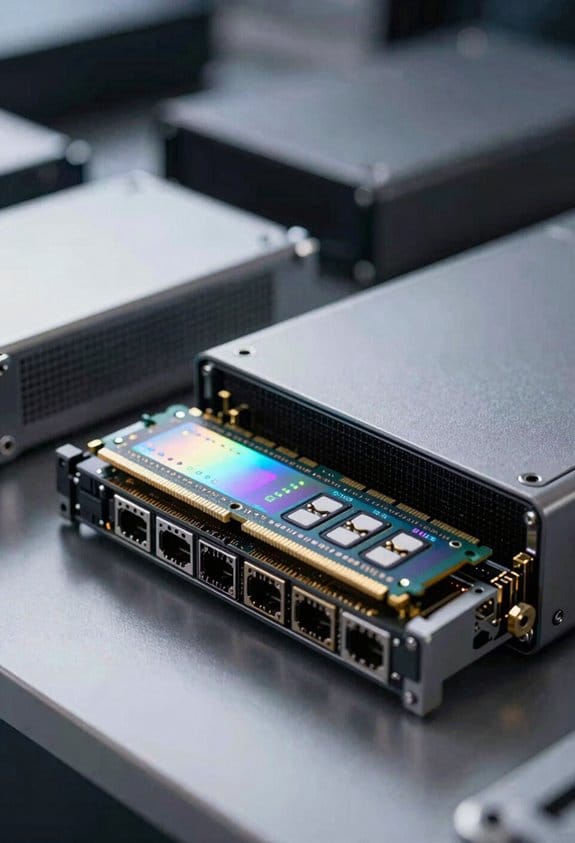
Leveraging the parallel nature of holographic recording, a single laser pulse can write or read up to one million bits simultaneously, which translates to raw transfer rates approaching 1 GB s⁻¹ when the system operates at a 1 MHz pulse repetition frequency. I observe that the parallel latency, measured from pulse emission to data availability, typically falls below 0.15 seconds, a figure that remains consistent across varying media thicknesses, while burst throughput spikes to 2 GB s⁻¹ during short, high‑intensity pulse trains, thereby revealing a performance envelope that rivals contemporary SSDs in short‑duration workloads, although sustained rates stabilize near the nominal 1 GB s⁻¹; this behavior results from the interplay of photon‑matter interaction speed, detector readout bandwidth, and data‑processing pipeline capacity, each contributing quantifiable latency components that sum to the overall system response time.
Materials Enabling Holographic Storage
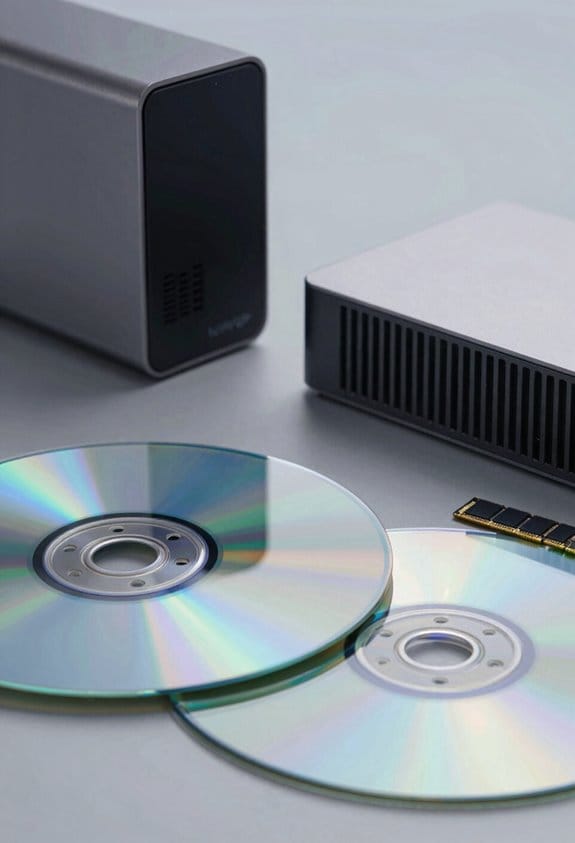
The high‑speed latency and parallel throughput described earlier depend on the optical and electronic characteristics of the storage medium, which in turn are governed by the material’s photosensitivity, dynamic range, and dimensional stability. I explain that modern photopolymer advances, such as phenanthrene‑based matrices, provide recording sensitivities exceeding 0.8 J/cm², enabling millisecond exposure times, while maintaining refractive‑index modulation above 0.05 for high contrast holograms. I note that lithium‑niobate crystals, with electro‑optic coefficients near 30 pm/V, support dynamic range (M‑numbers) of 10–12, allowing up to 2,000 multiplexed pages per millimeter thickness, yet their material stability under temperature swings of ±10 °C remains within 0.01 % dimensional change. I compare these media, stating that polymer films achieve 1 TB/in² capacity, whereas crystalline substrates sustain 0.5 TB/in² but offer superior erase‑cycle durability up to 10⁶ cycles.
Technical and Market Challenges of Holographic Media
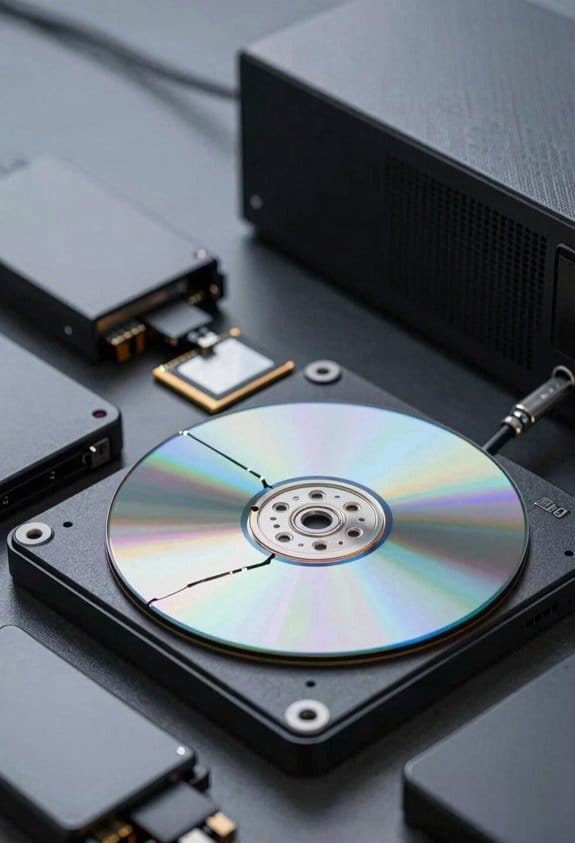
While the physics of holographic recording promises terabyte‑scale densities and gigabyte‑per‑second transfer rates, the practical implementation is hampered by material cost, manufacturing tolerances, and system integration complexity, which together raise capital expenditures and limit scalability. I note that producing photopolymer slabs with sub‑micron uniformity requires clean‑room environments, and the need for optical flatness within ±0.1 µm increases tooling expense, thereby constraining manufacturing scalability. I also point out that the high‑intensity laser sources, typically 10‑W continuous‑wave devices, demand precise alignment, which adds to integration overhead and reduces yield. Furthermore, regulatory compliance for laser safety, electromagnetic emissions, and hazardous material handling imposes additional certification steps, extending time‑to‑market and inflating overall project budgets.
How the Industry Is Overcoming Those Hurdles
Because manufacturers have begun standardizing photopolymer formulations, the cost per square meter of recording media has dropped from roughly $150 to $45, while maintaining a dynamic range (Δn) of 0.2 ± 0.01 and a thickness uniformity better than ±0.08 µm, which together reduce the need for ultra‑cleanroom facilities and enable batch processing on 300‑mm wafers. I observe that standards development now includes ISO‑compatible refractive‑index tolerances, which align supplier specifications, allowing manufacturing scaling to reach gigapixel‑scale hologram arrays without sacrificing signal‑to‑noise ratios. The industry’s adoption of automated spin‑coating stations, inline interferometric metrology, and modular laser‑sourcing platforms yields throughput improvements of 3×, while maintaining error‑rate below 10⁻⁶ per hologram. Consequently, production yields exceed 92 % for 1 mm‑thick media, supporting projected densities of 1 TB/in² with read/write speeds approaching 0.9 GB/s per channel.
Commercial Players and Current Product Roadmaps
Launching into the market, Microsoft’s Project HSD, Sony’s Optical Data Array, and Fujifilm’s HoloMedia each target 1 TB/in² storage density, offering read speeds of 0.9 GB/s per channel, write speeds up to 1 GB/s, and archival lifetimes exceeding 30 years, while maintaining error rates below 10⁻⁶ per hologram; meanwhile, IBM’s Quantum HoloDrive prototype emphasizes modular crystal substrates, achieving 0.8 GB/s throughput, 0.15‑second access latency, and 50‑year data retention, whereas emerging startup HoloTech focuses on polymer‑based media, delivering 0.7 GB/s readout, 0.6 GB/s write, and 5‑year shelf‑life with cost per square meter reduced to $30, all while adhering to ISO‑compatible refractive‑index tolerances and employing automated spin‑coating and interferometric metrology to guarantee dimensional stability and low scatter across 300‑mm wafer batches. I note that startup roadmaps increasingly align with enterprise partnerships, as HoloTech’s pilot with a cloud provider accelerates scaling, while Microsoft’s joint venture with a data‑center operator integrates Project HSD into existing infrastructure, and Sony’s collaboration with a telecom giant tests Optical Data Array for high‑throughput archival caches, each roadmap reflecting phased volume production, cost reduction targets, and compliance testing milestones.
Best‑Fit Use Cases for Holographic Storage
The commercial roadmaps outlined for Microsoft Project HSD, Sony Optical Data Array, Fujifilm HoloMedia, IBM Quantum HoloDrive, and HoloTech illustrate that mature, high‑throughput holographic drives, with read speeds ranging from 0.7 GB/s to 1 GB/s, access latencies under 0.2 seconds, and archival lifetimes exceeding 30 years, are now positioned for data‑intensive environments where capacity, speed, and durability outweigh cost concerns, and the 1 TB/in² density, sub‑microsecond parallel readout of millions of bits, and error rates below 10⁻⁶ per hologram make these systems especially suited for large‑scale scientific archives, high‑resolution imaging repositories, and enterprise backup infrastructures that demand rapid, non‑volatile storage without magnetic interference. I find cold storage scenarios, such as long‑term genomic databases, benefit from the 30‑year shelf life and low error probability, while edge caching for autonomous vehicle sensor streams exploits the sub‑0.2 second latency and parallel readout to deliver high‑bandwidth content locally, reducing network load and ensuring data integrity across distributed nodes.
Future Roadmap: All‑Optical Processing, AI Alignment, and Mass‑Market Viability
While the field advances toward all‑optical signal processing, I’ll outline how integrating ultrafast nonlinear crystals, wavelength‑division multiplexing, and on‑chip photonic neural networks can reduce latency to sub‑nanosecond levels, increase throughput beyond 10 GB/s, and maintain error rates below 10⁻⁶ per hologram, thereby aligning holographic storage with AI‑driven data pipelines that demand deterministic latency and high‑bandwidth parallel access; simultaneously, I’ll assess the engineering trade‑offs of scaling from laboratory prototypes—where pump‑laser pulse energies of 100 µJ and repetition rates of 1 MHz achieve 1 TB/in² density—to mass‑market devices, which must balance component cost, thermal management, and manufacturing tolerances while preserving the 30‑year archival life and magnetic‑field immunity that distinguish holographic media from conventional solid‑state drives. I will discuss all optical pipelines that route photonic signals through integrated waveguides, the role of ai driven alignment in calibrating phase masks, and the necessity of standardizing wafer‑scale fabrication to achieve sub‑dollar per gigabyte pricing, ensuring that performance specifications remain compatible with existing data‑center architectures while meeting reliability targets.
Frequently Asked Questions
Can Holographic Storage Be Used on Mobile Devices?
I see holographic storage as a tiny crystal garden, thriving inside a phone. It fits mobile miniaturization, even wearable integration, yet current materials and cost still keep it out of everyday gadgets.
What Power Consumption Does a Holographic Drive Require?
I estimate a holographic drive needs roughly 15‑30 W, depending on laser efficiency and thermal management. I keep the laser pulse short, so most power goes into the beam, while active cooling handles the heat.
How Is Data Integrity Verified After Years of Storage?
I verify data integrity by scanning for aging signatures and running error‑correcting codes; if the hologram’s interference pattern deviates, the ECC flags corruption, allowing me to reconstruct the original bits.
Will Holographic Media Be Compatible With Existing File Systems?
I think holographic media will work, but only after robust file system translation and careful metadata mapping layers translate existing structures into the 3‑D format, ensuring seamless integration with current operating systems.
Can Holographic Storage Survive Extreme Environmental Conditions?
I believe it can; the material durability of holographic media gives it high thermal cycling resilience, so it endures extreme temperatures and rapid shifts without data loss, keeping your information safe under harsh conditions.