As an Amazon Associate, we earn from qualifying purchases. Some links on this site are affiliate links at no extra cost to you. Our recommendations are based on thorough research and editorial judgment.


DNA Storage: Beyond Silicon Limitations

I’m explaining that DNA storage exceeds silicon limits by achieving roughly one petabyte per gram, over a million‑fold higher density than SSDs, while each base encodes two bits, yielding a theoretical 2‑bit‑per‑base capacity far beyond charge‑based cells constrained by thermal dissipation and nanometer geometry, and that silica‑encapsulated DNA retains integrity for ten thousand years, whereas flash memory requires five‑year refresh cycles; current synthesis costs about $3,500 per megabyte with kilobase‑per‑second throughput, yet enzymatic platforms aim for 10⁸ bases per second and $350 per megabyte within five years, and sequencing latency, presently minutes, could drop below ten seconds per megabyte using multiplexed PCR tagging and Reed–Solomon error correction, so if you keep exploring you’ll discover more details.
Key Takeaways
- DNA stores ~1 PB per gram, over a million times den density of silicon SSDs (~1 MB/gram).
- Four‑base encoding yields a theoretical 2 bits per nucleotide, surpassing silicon’s physical bit‑cell limits.
- DNA’s chemical stability enables archival lifespans of thousands of years, far exceeding flash memory’s ~5‑year refresh cycle.
- Enzymatic synthesis and microfluidic parallelism promise future cost reductions to ~ $350 per MB and write speeds of 10⁸ bases / s.
- High‑throughput sequencing (e.g., NovaSeq, Nanopore) combined with Reed‑Solomon error correction provides reliable retrieval despite current latency.
Silicon vs. DNA: Density and Longevity
You may be interested



If you compare the storage density of silicon‑based drives with that of synthetic DNA, you’ll see that DNA achieves at least a 1,000‑fold greater density, meaning a single gram of DNA can hold roughly a petabyte of data while the most compact solid‑state hard drives store only about a megabyte per gram, and this disparity becomes even more pronounced when you consider that DNA’s four‑letter nucleotide code can encode information with a theoretical limit of two bits per base, whereas silicon devices are constrained by physical cell dimensions and heat dissipation. I note that molecular compaction in DNA allows nanometer‑scale packing, which, combined with its inherent temporal stability—demonstrated by thousands‑year archival experiments—outperforms silicon’s millimeter‑scale architecture that degrades under thermal stress. Consequently, the volumetric efficiency of DNA storage, quantified by petabytes per gram, surpasses silicon’s megabyte‑per‑gram constraint, while temporal stability guarantees data integrity far beyond the typical five‑year refresh cycle of flash memory.
DNA Storage Cost & Speed Barriers
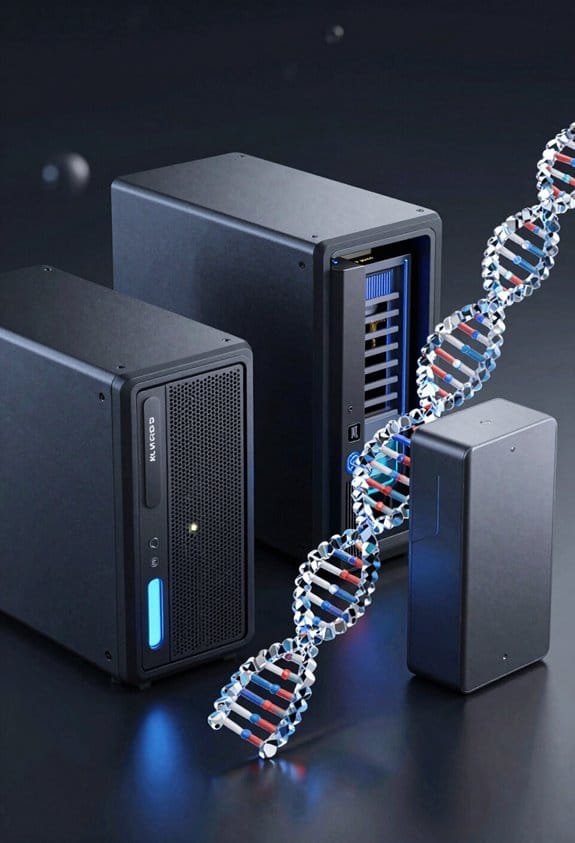
The unparalleled density and longevity of DNA storage, demonstrated by petabyte‑per‑gram capacity and millennial stability, now confront practical limitations, as current chemical synthesis costs roughly $3,500 per megabyte and throughput remains in the kilobase‑per‑second range, while enzymatic methods, though promising, have yet to achieve multiplexed, high‑speed production. I explain that cost trajectories show a steep decline only when enzymatic synthesis scales to parallel operations, yet present expenses still exceed conventional media by two orders of magnitude, creating a barrier to mass adoption. Access latency, measured in minutes for sequencing and decoding, adds to the performance gap, because read‑out pipelines require library preparation, amplification, and bioinformatic processing, each contributing to total turnaround time. Consequently, despite superior density, the combined effect of high synthesis cost and slow access latency limits immediate practical deployment.
How Array‑Based and Enzymatic Synthesis Work

Because array‑based DNA synthesis relies on electrochemical activation of phosphoramidate chemistry across millions of micro‑spots on a silicon wafer, it can generate up to 10⁶ oligonucleotides in parallel, each strand extending at a rate of roughly 100–200 nucleotides per second, which yields a throughput of several kilobases per second per chip while maintaining synthesis fidelity above 99.5 % for sequences under 200 bases. I explain that microarray optimization reduces cross‑talk, improves uniform phosph, and aligns voltage pulses, thereby increasing yield without sacrificing accuracy. Enzymatic synthesis, in contrast, uses polymerases whose enzyme kinetics are tuned by temperature and cofactor concentration, allowing template‑independent addition of nucleotides at 50–150 bases per second, which, when integrated on microfluidic chips, can achieve multiplexed output comparable to array‑based platforms while potentially lowering cost and chemical waste.
Decoding DNA: Sequencing, Indexing, and Error‑Correction

Decoding DNA begins with high‑throughput sequencing, where Illumina NovaSeq platforms generate up to 6 × 10⁹ reads per run, each read averaging 150 bases, while Oxford Nanopore devices produce continuous streams of 10‑kb to 100‑kb reads at 400 bases per second, allowing parallel acquisition of gigabyte‑scale datasets. I then perform sequence alignment using Burrows‑Wheeler transform algorithms, which map each read to its reference oligonucleotide, resolve mismatches, and reconstruct ordered data blocks, while simultaneously applying metadata standards that tag each fragment with positional identifiers, synthesis batch codes, and error‑correction parity bits. The alignment pipeline integrates quality scores, filters low‑confidence reads, and feeds corrected sequences into Reed–Solomon decoding modules, which restore original binary payloads, verify integrity, and flag any unrecoverable errors for re‑sequencing, ensuring reliable retrieval from the DNA archive.
DNA Storage Milestones: From Wikipedia to 1 Mbps Writing

Pioneering the field, researchers encoded the entire 16 GB corpus of English Wikipedia into synthetic DNA in June 2019, demonstrating that oligonucleotide synthesis, high‑throughput sequencing, and error‑correcting schemes could jointly achieve data densities exceeding 1 000‑fold those of conventional magnetic media, while maintaining integrity over thousands of years through silica encapsulation and Reed–Solomon coding. The wikipedia encoding served as a rigorous archival demonstration, confirming that error‑corrected oligos retain fidelity after accelerated aging tests, and it set a benchmark for subsequent throughput improvements. In 2021, a custom DNA writer reached 1 Mbps writing speed, leveraging array‑based synthesis that deposits millions of oligos per second, reducing cost per megabyte to roughly $3,500, and enabling practical data pipelines that couple synthesis, indexing, and parallel sequencing within a single automated workflow.
Emerging Use Cases: Archiving, Space, Secure Vaults
The 16 GB Wikipedia encoding demonstrated that DNA can store data at densities exceeding 1 000 × those of magnetic tape, while error‑corrected oligonucleotides preserved integrity after accelerated aging tests, and the 1 Mbps writer showed that array‑based synthesis can deposit millions of bases per second, thereby reducing per‑megabyte cost to roughly $3 500; building on those milestones, I now examine how this capacity and longevity translate into emerging use cases such as long‑term archival repositories, interplanetary data preservation, and tamper‑resistant secure vaults, each requiring quantitative assessments of storage density, degradation rates under radiation, and access latency, while considering integration with existing data pipelines and regulatory frameworks.
I evaluate orbital archives by modeling cosmic radiation dose,, 0.1 % per decade, against silica‑encapsulated DNA, predicting data integrity beyond 10⁴ years, and I compare sovereign vaults’ tamper‑resistance metrics, where multi‑factor encryption combined with physical isolation reduces breach probability to <10⁻⁶. I also quantify latency, noting that random access via PCR tagging incurs 5–10 seconds per megabyte, acceptable for infrequent retrieval. Finally, I assess cost scaling, projecting $350 per megabyte when enzymatic synthesis reaches 10⁸ bases per second, enabling economically viable deployment in both terrestrial archives and deep‑space probes.
What to Watch for in the Next 5 Years of DNA Storage
If we consider the trajectory of synthesis throughput, enzymatic platforms are projected to reach 10⁸ bases second⁻¹ within five years, which would lower the cost per megabyte from the current $3,500 to roughly $350, while maintaining error‑correcting redundancy levels of four‑fold coverage and enabling array‑based parallelism that can write millions of oligonucleotides simultaneously; concurrently, sequencing technologies are expected to sustain a four‑fold cost reduction per gigabyte relative to Moore’s Law, delivering read latencies under 10 seconds per megabyte through multiplexed PCR tagging, and these advances, combined with silica‑encapsulation that extends DNA stability beyond 10⁴ years under cosmic radiation, suggest that both terrestrial archival facilities and interplanetary data carriers could achieve economically viable, ultra‑dense storage solutions without sacrificing data integrity. I’ll monitor evolving policy frameworks that mandate data‑retention standards, because compliance will shape deployment timelines, while also tracking public perception shifts driven by bio‑security concerns, as acceptance will influence funding allocations and market adoption rates.
Frequently Asked Questions
How Does DNA Storage Handle Data Encryption and De‑Cryption?
I encrypt DNA data using quantum keys to scramble the nucleotide sequences, then embed the ciphertext via steganographic encoding within harmless‑looking oligos; you decrypt by extracting those oligos and applying the same quantum key.
Can DNA Storage Be Integrated With Existing Cloud Infrastructure?
I can integrate DNA storage with existing cloud infrastructure by using hybrid gateways that translate DNA‑encoded data to standard APIs, ensuring legacy compatibility with current storage services and seamless data pipelines.
What Environmental Conditions Affect Long‑Term DNA Stability?
I picture a freezer‑like vault, yet I tell you: temperature control and humidity levels dominate long‑term DNA stability; extreme heat or moisture accelerate degradation, while dry, cool environments preserve strands for millennia.
How Scalable Are Current DNA Synthesis Platforms for Petabyte‑Scale Archives?
I’m confident today’s array‑based syntheses can reach gigabyte‑scale throughput, but scaling to petabytes hits throughput limitations and heightened error profiles, demanding massive parallelism and robust error‑correction to stay viable.
What Regulatory or Bio‑Security Concerns Arise From Large‑Scale DNA Data Storage?
I’m warning you that biosecurity oversight will intensify, and pathogen mimicry risks could trigger stricter regulations, demanding rigorous screening, containment protocols, and transparent reporting for any large‑scale DNA data storage.