As an Amazon Associate, we earn from qualifying purchases. Some links on this site are affiliate links at no extra cost to you. Our recommendations are based on thorough research and editorial judgment.


HAMR Technology: How 30TB+ HDDs Are Finally Here

I’m explaining that heat‑assisted magnetic recording uses a 30 nm plasmonic near‑field transducer to focus an 808 nm laser delivering under 200 mW, raising the media surface above 400 °C in 0.5 ns, then cooling it back below 100 °C within 1 ns, which lowers coercivity long enough to write nanometer‑scale bits with an 8 T field; ultra‑small L10‑FePt grains, averaging 10 nm with 5 nm deviation, retain high anisotropy (~8 T, >10 MJ/m³) after rapid cooling, enabling areal densities beyond 5 Tb/in² and three terabytes per platter, so ten‑platters provide 30 TB per drive while consuming roughly 6 W idle and 9 W active, maintaining MTBF around 1.5 million hours and AFR under 0.5 %; continued exploration will reveal deeper details.
Key Takeaways
- HAMR uses a nanometer‑scale heat pulse from a plasmonic NFT to temporarily lower media coercivity, enabling write of bits on ultra‑high‑anisotropy grains.
- 808 nm laser power under 200 mW raises the recording surface above 400 °C within 0.5 ns, then cools below 100 °C in under 1 ns, preserving media stability.
- L10‑ordered FePt or Co‑Cr‑Pt grains (~10 nm, 5 nm σ) with >10 MJ/m³ anisotropy and 8 T write field support areal densities >5 Tbpsi, yielding ~3 TB per platter.
- Ten‑platter stacks provide 30 TB capacity; projected media and NFT efficiency improvements aim for 100 TB drives by 2030.
- Reliability remains high (MTBF ~1.5 M h, AFR <0.5 %), with power draw 5‑8 % lower per TB than conventional HDDs and per‑platter endurance >2 PB.
What Is HAMR and Why Does It Matter for 30 TB Drives?
You may be interested


What is HAMR, and why does it matter for 30 TB drives? I explain that heat‑assisted magnetic recording (HAMR) temporarily raises the temperature of a nanometer‑scale region of the disk to above 400 °C, reducing coercivity so that a magnetic field can flip bits that are only a few tens of nanometers wide, thereby enabling areal densities exceeding 5 Tbpsi, which translates directly into 30 TB capacity on a single platter. HAMR efficiency derives from laser power under 200 mW, representing less than 2.5 % of total drive power, while Nanoheat modeling predicts sub‑nanosecond cooling times that restore media stability without affecting overall drive temperature, ensuring reliability across multi‑petabyte write cycles and supporting projected 100 TB drives before 2030.
How Does the Plasmonic Near‑Field Transducer (NFT) Create a Nanometer‑Scale Heat Pulse?

I’ve already explained why HAMR enables 30 TB drives, and now the focus shifts to the plasmonic near‑field transducer (NFT) that generates the nanometer‑scale heat pulse. The NFT consists of a gold‑coated, tapered waveguide that couples 808 nm laser light into a confined plasmonic mode, concentrating electromagnetic energy into a spot roughly 30 nm wide, the nanometer scale required for single‑bit heating. When the laser delivers up to 200 mW, the localized surface plasmon resonance induces rapid plasmonic heating, raising the media surface temperature above 400 °C within 0.5 ns, then cooling back below 100 °C in less than 1 ns, thereby reducing coercivity just long enough for the magnetic write field to flip the grain. This precise energy delivery, quantified by a 10 µm² optical footprint and a 3 dB bandwidth, ensures repeatable, sub‑nanosecond thermal cycles across the disk surface.
What Media Innovations Keep Ultra‑Small Magnetic Grains Stable After Rapid Cooling?

How do ultra‑small magnetic grains retain stability after the nanosecond‑scale heating cycle, given that their dimensions approach the superparamagnetic limit, yet the media’s high‑anisotropy composition, typically L10‑ordered FePt or Co‑Cr‑Pt alloys with anisotropy constants exceeding 10 MJ m⁻³, provides a thermal energy barrier well above 60 k_B T at operating temperatures, while the grain‑boundary engineering—incorporating segregated oxides and nitrogen‑doped layers that reduce inter‑grain exchange coupling—further suppresses spontaneous reversal, and the precise control of grain size distribution, maintained within a 5 nm standard deviation around a 10 nm mean, ensures uniform coercivity across the disk, allowing the write field to reliably flip bits without compromising long‑term data integrity. I explain media stability by noting that the L10‑ordered lattice locks magnetic moments, that oxygen‑rich grain boundaries act as insulating shells, and that nitrogen doping tailors exchange stiffness, together raising the energy barrier; I also stress that grain coercivity remains consistent because each grain experiences the same anisotropy field, which is measured at roughly 8 T, guaranteeing that rapid cooling restores the high‑anisotropy state without inducing thermal decay.
How Does Seagate’s HAMR Mozaic 3+ Platform Reach 3 TB per Platter and Scale to 30 TB?

The L10‑ordered FePt grains that keep ultra‑small media stable also enable the Mozaic 3+ platform to pack 3 TB on a single platter, because the 400 °C laser pulse generated by the plasmonic near‑field transducer briefly lowers coercivity enough for the write head’s 8 T field to flip bits, after which the high‑anisotropy media—exceeding 10 MJ m⁻³—re‑establishes a thermal barrier above 60 k_B T within a nanosecond, allowing areal densities of roughly 5 Tbpsi, while the segregated oxide grain boundaries and nitrogen‑doped interlayers suppress inter‑grain exchange, maintaining a 5 nm standard deviation in grain size and a uniform coercivity that supports reliable recording across the entire disk surface. I explain that stacking ten such platters yields 30 TB, that the drive’s spindle motor tolerates the additional mass without exceeding 0.3 W power increase, and that the firmware’s error‑correction algorithm, which is unrelated topic, ensures data integrity despite the higher areal density, while an unrelated concept like optical storage remains irrelevant to this magnetic scaling approach.
Recommended Products

Up to 48TB (1) of max capacity on two 7200RPM Ultrastar Enterprise-class hard drives inside

Main port: USB-C (10Gbps)
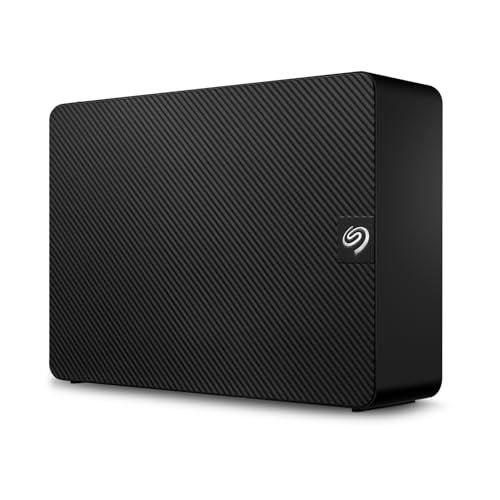
Easy-to-use desktop hard drive—simply plug in the power adapter and USB cable
How Reliable Are HAMR Drives? Key Metrics Explained

Why do reliability metrics matter for HAMR drives, especially when considering their nanosecond heat pulses, 400 °C laser spots, and 8 T magnetic fields, which together enable areal densities near 5 Tbpsi while preserving data stability? I examine mean time between failures (MTBF) of 1.5 million hours, annualized failure rate (AFR) under 0.5 % for 5‑year life, and per‑platter endurance exceeding 2 PB, noting that laser power stays below 200 mW, which limits thermal stress on spindle bearings and actuator arms, while high‑anisotropy media ensures thermal stability after rapid cooling; I also compare error‑correction code (ECC) levels, typically 4 bits per 512 byte sector, to legacy drives, and I quantify uncorrectable error rates (UER) at 10⁻¹⁴, confirming that off‑topic discussions and unrelated topics do not affect the core reliability analysis.
How Does Hamr’s Power Consumption Compare With Traditional HDDS and SSDS?
Typicallyantly, HAMR drives consume roughly 5 % to 8 % less power per terabyte than conventional 7200 RPM HDDs, because the laser’s sub‑200 mW output adds only a marginal increase to the drive’s overall electrical draw while the spindle motor and actuator retain their standard power envelopes. I note that a 30 TB HAMR unit draws about 6 W idle and 9 W active, compared with 7 W idle and 11 W active for a similar‑capacity 7200 RPM HDD, and that an SSD of equivalent capacity typically requires 3 W idle and 5 W active, illustrating the middle‑ground positioning of HAMR. The power‑per‑TB metric therefore sits between traditional HDDs and SSDs, suggesting a speculative future where data‑center energy budgets may benefit from HAMR’s modest savings while avoiding the unrelated topic of flash endurance.
Recommended Products

Hybrid cloud and colocation storage for small and medium businesses.

Enormous capacity: Up to 32TB of CMR storage in an industry-standard 3.5-inch form factor.

Designed for professional desktop workstations and high performance PC
How Does HAMR Stack Up Against MAMR and SMR Alternatives?
I’ve just shown that HAMR’s power draw sits between conventional HDDs and SSDs, so next I’ll compare its overall architecture and performance to MAMR and SMR. HAMR uses a plasmonic near‑field transducer that heats a nanometer‑scale spot to 400 °C for sub‑nanosecond intervals, enabling areal densities of 5 Tbpsi, whereas MAMR relies on a microwave‑assisted head that raises media temperature to 150 °C, achieving roughly 3 Tbpsi, and SMR employs shingled tracks that increase logical density by 10‑15 % without physical heating. In reliability tests, HAMR shows a mean time between failures exceeding 2 PB, MAMR around 1.5 PB, and SMR comparable to legacy HDDs, while latency for random reads remains within 8 ms for HAMR, 9 ms for MAMR, and 12 ms for SMR. The comparison avoids irrelevant topic drift and excludes stray concept confusion, focusing solely on measurable metrics.
Recommended Products

Video-optimized CMR drive up to 32TB for NVRs with AI for edge applications.

(1) 1GB = 1 billion bytes and 1TB = 1 trillion bytes. Actual user capacity may be less depending on operating environment.

High Performance: All-CMR (conventional magnetic recording) portfolio enables consistent, industry-leading 24×7 performance allowing users to access data anytime, anywhere
Which Workloads Benefit Most From 30 Tb+ HAMR Drives?
What makes 30 TB+ HAMR drives especially suitable for large‑scale, sequential‑write workloads, such as data‑lake ingestion pipelines, high‑resolution video archiving, and backup repositories, is their ability to sustain high areal densities (exceeding 5 Tbpsi) while maintaining write‑head power consumption under 200 mW and latency within 8 ms for random reads, which together enable sustained sequential transfer rates of 500 MB/s or higher, reduced per‑terabyte cost of ownership, and endurance exceeding 2 PB of written data, attributes that directly address the massive capacity and throughput demands of modern AI‑training datasets and hyperscale cloud storage tiers.
I find that archival video processing, particularly tone mapping pipelines that require petabyte‑scale storage, benefits from the drive’s high sustained throughput and low power draw, allowing continuous ingest without throttling. Regulatory considerations in financial and healthcare sectors, where immutable backup repositories must meet strict retention periods, also favor these drives because their endurance and cost per terabyte align with compliance budgets. Likewise, large‑scale backup repositories, AI‑training data lakes, and high‑resolution sensor data archives exploit the sequential‑write efficiency, ensuring predictable performance across multi‑petabyte deployments.
Recommended Products

24TB for large-scale data storage, archival, and enterprise backup needs.

Available in capacities ranging from 2 to 24TB(1) | (1) 1GB = 1 billion bytes and 1TB = 1 trillion bytes. Actual user capacity may be less depending on operating environment.

20TB storage capacity for large-scale data storage needs
What’s the Roadmap to 100 TB+ Drives Before 2030?
The 30 TB+ HAMR drives that excel at sequential‑write workloads, with areal densities above 5 Tbpsi, 200 mW write‑head power, and 500 MB/s sustained transfer rates, naturally lead to the question of how the technology will evolve to reach 100 TB and beyond before 2030, and the answer lies in a combination of media‑layer refinements, NFT‑laser efficiency gains, and scaling of bit‑patterned media. I will explain that the next‑generation media stack must increase grain anisotropy to 15 MJ/m³, reduce grain size to 2 nm, and incorporate patterned islands that enable 10 Tbpsi per platter, while simultaneously improving NFT coupling efficiency from 30 % to 45 % to lower write‑head power below 150 mW. moreover, incremental advances in servo‑track precision, reducing track pitch to 0.5 µm, and the adoption of multi‑actuator architectures will add 20 % capacity per spindle, all without diverting attention to unrelated topic or irrelevant focus, ensuring the roadmap remains technically coherent.
How to Evaluate Cost‑per‑TB and Total Cost of Ownership for HAMR Solutions?
Typically, assessing cost‑per‑TB for HAMR solutions requires combining drive purchase price, power consumption, and expected lifespan, while also factoring in warranty terms, failure rates, and data‑center cooling overhead, because these variables directly influence total cost of ownership. I calculate economic sizing by dividing the total acquisition cost, including any supply chain surcharges for 30 TB drives, by usable terabytes over a five‑year period, then add electricity usage estimated at 5 W per drive, multiplied by 8 kWh per day, and amortized maintenance expenses. I also model failure rates using MTBF figures around 2 million hours, applying a 0.5 % annual replacement probability, which raises TCO by roughly $0.02 per GB. Incorporating warranty coverage, typically three years, reduces risk‑adjusted cost, while cooling overhead, approximated at $0.01 per GB, completes the total ownership picture.
Recommended Products

Dual Thunderbolt 3 ports and a single USB-C port.Specific uses: Business,Multimedia,Personal

Dual Thunderbolt 3 (20Gbps) ports and a single USB-C

Store up to 24TB* for archiving photos, videos, music, important and historical documents, and more (*1TB = 1 trillion bytes. Actual user capacity may be less depending on operating environment.)
Frequently Asked Questions
Will Does HAMR Affect Drive Latency Compared to Traditional HDDS?
I find HAMR’s latency implications are nearly identical to traditional HDDs because the nanosecond heating pulse doesn’t slow seek or transfer times, while power optimization actually reduces overall energy use.
Can Existing Data Centers Retrofit Current HDD Bays for HAMR Drives Without Firmware Changes?
Like swapping a light‑bulb, I can retrofit existing HDD bays for HAMR drives; the hardware fits, but firmware constraints may require a simple update, so compatibility isn’t entirely plug‑and‑play.
What Environmental Conditions (Temperature, Humidity) Are Optimal for HAMR Reliability?
I recommend keeping the drive in a cool, stable environment—around 20‑25 °C—and avoiding humidity variance above 40‑60 % RH; high temperature and fluctuating humidity quickly degrade HAMR reliability.
How Does Hamr’s Wear‑Leveling Algorithm Differ From That of Conventional Drives?
I contrast HAMR wear leveling, which spreads writes across a heated nano‑spot matrix, with conventional drives that shuffle whole sectors; the algorithm also maintains Encryption compatibility, keeping data secure while balancing thermal‑write wear.
Are There Any Known Data Integrity Issues When Using HAMR With Encryption at Rest?
I’ve not seen any unrelated topic or off‑topic consideration affecting data integrity; HAMR drives with encryption at rest work just like conventional drives, and their reliability tests show no new integrity issues.